How Do I Get My Business Recommended by ChatGPT?
First: ChatGPT Can Search the Web
ChatGPT is no longer limited to information learned during model training.
When a question would benefit from current information, ChatGPT can search the web and cite websites it believes are relevant.
OpenAI also states that public websites can appear in ChatGPT search results, provided they are accessible to its search crawler.
For a local business, that means your website can potentially become one of the sources ChatGPT uses when answering questions about your industry or market.
But your website is only part of the picture.
AI Needs to Understand Your Business as an Entity
Imagine someone introduces you to a person you've never met.
They tell you:
“Jimmy owns a company somewhere in Florida that does something with AI.”
You don't know enough to confidently recommend Jimmy to anyone.
Now imagine several reliable people independently tell you:
Jimmy owns RealReach.
RealReach helps businesses use AI.
RealReach is located in the Tampa Bay area.
RealReach helps companies improve local visibility.
RealReach provides AI lead capture and follow-up.
RealReach has published articles explaining AI search.
RealReach appears consistently across reputable business platforms.
Suddenly, you have a much clearer picture.
AI search works in a similar way.
The clearer and more consistent your business information is across the web, the easier it is for search engines and AI systems to understand what your business actually represents.
1. Make Your Website Extremely Clear
Your website should answer four questions almost immediately:
Who are you?
What do you do?
Where do you do it?
Who do you do it for?
That sounds obvious.
But many websites don't.
A homepage filled with phrases like:
“Delivering innovative solutions for today's evolving marketplace.”
tells an AI almost nothing.
Compare that with:
“ABC Plumbing provides residential plumbing, water heater repair and drain cleaning throughout Tampa, Wesley Chapel and Land O' Lakes, Florida.”
Now the business, services and geography are clear.
Specificity helps humans.
It also helps machines.
2. Build Strong Service Pages
If your company offers five major services, those services shouldn't be buried inside one paragraph on your homepage.
Give important services their own pages.
For example:
Tile & Grout Cleaning
Grout Color Sealing
Shower Restoration
Commercial Tile Cleaning
Grout Repair
Each page gives search engines another clear signal about what the company actually does.
It also creates information that an AI system can potentially use when someone asks a very specific question.
3. Be Specific About Where You Work
Local AI searches are heavily dependent on location.
ChatGPT can use general location information when helping users find nearby businesses and local recommendations.
So don't make AI guess whether you serve someone's city.
Clearly identify your service areas.
That may include:
Your city
Nearby cities
Neighborhoods
Counties
Major service areas
But don't create hundreds of thin pages that simply swap one city name for another.
Useful local pages should contain real information about the service and the market.
4. Take Your Google Business Profile Seriously
Your Google Business Profile remains one of the most important sources of structured local business information.
Google says it compiles business information from several sources, including official websites, third-party data, user contributions, photos, reviews and information supplied directly by business owners.
Google also recommends keeping Business Profile information complete and accurate because businesses with complete information are more likely to appear in relevant local search results.
Make sure your profile has accurate:
Business name
Category
Phone number
Website
Hours
Service area
Services
Photos
Business description
Reviews
Think of your Google Business Profile as one of the most important pieces of your business's digital identity.
5. Get Listed in Relevant Business Directories
Directories aren't dead.
Their role may actually become more interesting in the age of AI.
A directory gives search engines another independent source confirming:
This business exists.
It operates in this location.
It provides these services.
This is its website and phone number.
The key isn't appearing in every random directory on the internet.
It's appearing in credible and relevant places where your business information is accurate and complete.
That can include:
Industry directories
Local directories
Professional associations
Chambers of commerce
Community platforms
Niche marketplaces
Consistency matters.
If five sources describe your company five different ways, you're creating unnecessary ambiguity.
6. Earn Reviews
Reviews do more than influence customers.
They create additional context about your business.
Customers naturally mention things like:
Services they received
Employees they worked with
Cities or neighborhoods
Products
Problems you solved
Experiences they had
That creates a growing body of real-world language associated with your business.
Don't manipulate reviews.
Don't tell customers exactly what to write.
Just consistently ask happy customers to share their genuine experience.
7. Publish Content That Answers Real Questions
One of the easiest mistakes businesses make is writing every article around themselves.
“Why We're the Best...”
“Why Choose Us...”
“Our Amazing Services...”
Instead, answer the questions your customers actually ask.
A roofing company might write:
How Much Does a New Roof Cost in Tampa?
A chiropractor might write:
Should I See a Chiropractor After a Minor Car Accident?
A home builder might write:
How Long Does It Take to Build an Infill Home in Tampa?
A nursery might write:
What Palm Trees Grow Best in Tampa Bay?
Those are the kinds of questions people increasingly ask conversational AI.
Create the answer before they ask.
8. Make Sure AI Crawlers Can Access Your Site
Here's a technical one many businesses will miss.
OpenAI operates a crawler called OAI-SearchBot for ChatGPT search.
OpenAI says businesses that want their content eligible to appear in ChatGPT search should make sure they aren't blocking OAI-SearchBot through their website's robots.txt file or security settings.
You can have fantastic content and still make it harder for an AI search engine to discover if you've accidentally locked the door.
9. Keep Your Information Fresh
AI systems are increasingly capable of searching for current information.
That means an abandoned website isn't doing your business any favors.
You don't need to publish something every day.
But your online footprint should show signs of life.
Update:
Products
Services
Team members
Locations
Photos
FAQs
Articles
Business listings
Google Business Profile content
If something about your business changes, update it everywhere that matters.
10. Don't Try to “Game ChatGPT”
There is already an entire cottage industry selling shortcuts for “ranking #1 in ChatGPT.”
Be careful.
OpenAI explicitly says placement in ChatGPT search isn't guaranteed and results are ranked using multiple factors intended to surface relevant and reliable information.
There isn't currently a magical schema tag that says:
RECOMMEND MY BUSINESS.
The long-term strategy is much less exciting — and much more powerful.
Build a business that is:
Easy to discover.
Easy to understand.
Consistent across the web.
Mentioned by credible sources.
Useful enough to recommend.
SEO Isn't Dead. It's Expanding.
We don't believe AI search replaces SEO.
It expands it.
Traditional SEO asked:
“How do we help Google understand this page?”
AI search adds another question:
“How do we help machines understand this business?”
That means your website, Google Business Profile, reviews, directories, content, social presence and structured data increasingly work together as one connected ecosystem.
Your website is no longer the entire strategy.
It's part of your digital business identity.
A Simple AI Visibility Test
Try this yourself.
Open ChatGPT, Gemini or another AI search tool and ask:
“Who are the best [your service] companies in [your city]?”
Then try:
“Who would you recommend for [specific problem] in [your city]?”
Look at the companies being recommended.
Then ask:
“Why did you recommend those businesses?”
Look at the sources.
Look at their websites.
Look at their reviews.
Look at where they're listed.
You may start seeing a pattern.
The Businesses AI Understands Will Have an Advantage
The shift from search engines to answer engines isn't going to happen overnight.
Google isn't disappearing.
Websites aren't disappearing.
SEO isn't disappearing.
But the way customers discover businesses is changing.
And businesses that make themselves easy for AI systems to understand will be better positioned as that behavior continues to grow.
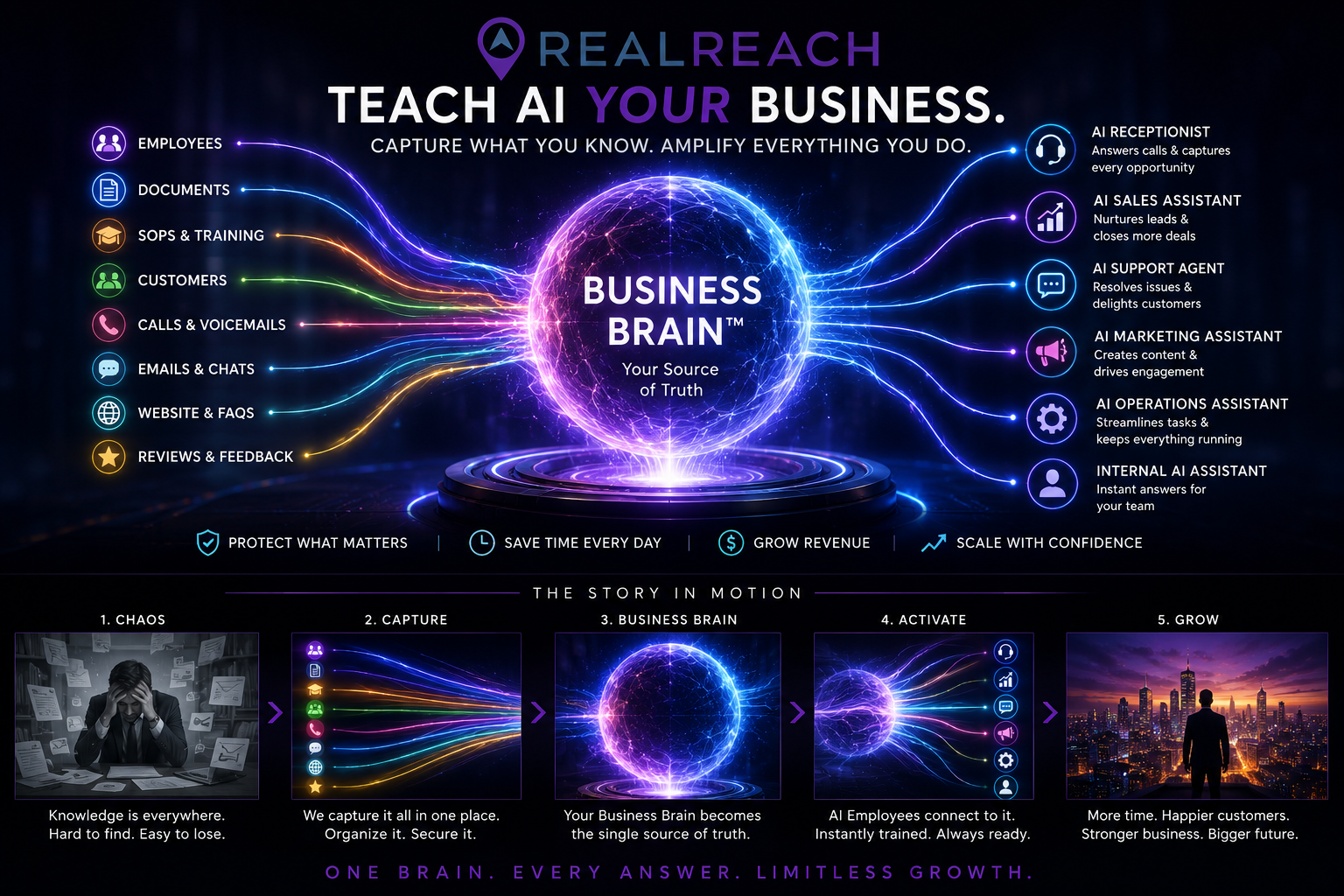
At RealReach, we're helping businesses build that foundation now — creating stronger digital identities, improving local visibility, organizing business knowledge and preparing companies for an increasingly AI-driven search environment.
Because the next customer may not search for you.
They may simply ask AI:
“Who should I call?”
The goal is to make sure AI knows your name.
Share this article
Instagram and TikTok use copy-and-paste sharing.
About RealReach

RealReach